Environmental Context and Strategic Moisture Mitigation
In high-humidity coastal zones, moisture management is the fundamental pillar of structural durability and occupant safety. These regions are uniquely susceptible to hydrologic stressors, ranging from sudden storm surges to prolonged saturated ground conditions. From an engineering perspective, we must address the hygroscopic nature of the coastal environment, where elevated ambient humidity and hydrostatic pressure from rising water tables accelerate the degradation of building assemblies. Strategic mitigation must account for these dynamics to prevent structural instability and pervasive biological hazards. This is written for homeowners around Mckinney, TX who are looking into emergency flood damage extraction company and want the honest version rather than a sales page.
- Regional Flood Dynamics: The engineering response depends on the specific flood mechanism. Overbank flooding, occurring along rivers and streams, is driven by watershed precipitation and can persist for weeks. Conversely, urbanized watersheds are prone to flash flooding, where impervious surfaces—such as roofs and parking lots—rapidly overwhelm drainage systems.
- Health and Structural Risk Factors: Stagnant water serves as a primary breeding ground for mold and pathogens, including E. coli and hepatitis, often transported via overloaded sewer lines. A critical, often overlooked risk is the inundation of forced-air systems; even after water recedes, sediments left in the ducts are circulated and inhaled by occupants, severely compromising indoor air quality.
- Connective Tissue: These external environmental pressures directly trigger the hygroscopic response of timber, where saturated ground conditions facilitate capillary suction through the building envelope.
Analytical Assessment of Timber Response to Water Ingress
Timber is a hygroscopic material that undergoes radical physical and mechanical changes during "soaking" events, which are the primary cause of building damage in slow-moving coastal floods. While a structure may appear sound after water recedes, its mechanical integrity is often compromised by deep-seated moisture and sediment absorption.
- Mechanical Deformation Analysis: As timber substrates soak, fibers swell, creating internal stresses. If drying is unmanaged, wood will crack, split, or warp. Engineered products are particularly vulnerable; plywood suffers from delamination, while particleboard may lose all structural integrity. Furthermore, stairs weakened by soaking become secondary structural hazards, prone to collapse under load.
- Water Pathway Evaluation:
- Capillary Suction and Seepage: Moisture moves vertically and horizontally through porous ground and under foundation barriers, saturating crawlspaces via wick action.
- Gravity Accumulation: Materials act as sponges for pollutants and sediment. This trapped moisture facilitates the absorption of industrial chemicals and organic waste, rotting timber from within.
- Joint and Cavity Traps: Water trapped in wall cavities and insulation fosters decay if the assembly is not stripped and dried.
- Impact on Secondary Systems: Structural shifts can rupture gas lines or compromise electrical systems, creating electrocution risks when components short out. Secondary finishes, such as gypsum wallboard, lose structural capacity and will "fall apart" if manipulated while wet.
- Connective Tissue: The hidden nature of these structural risks necessitates the integration of rigorous engineering controls and regulatory standards into the pre-construction phase.
Technical Moisture Control Surveillance Plan
A data-driven surveillance plan using IICRC S500 standards is essential for ensuring structural integrity and insurance defensibility. This moves remediation from subjective assessment to a verified engineering process.
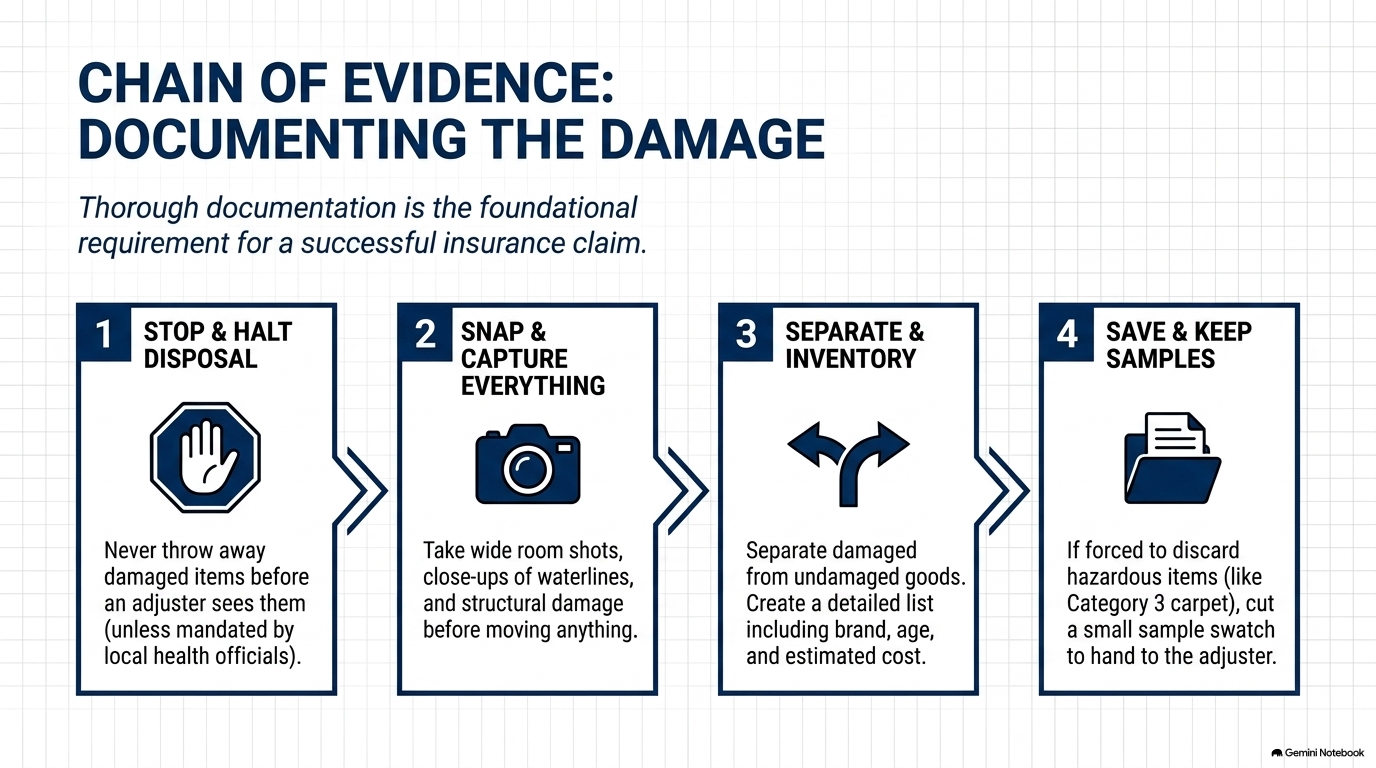
- Initial Scene Capture and Baseline Mapping: Professionals must establish time-stamped photographic evidence and "baseline moisture readings" using calibrated meters and thermal imaging to map pre-drying content in all substrates.
- Measurement Protocols: Daily drying logs must track:
- Psychrometric Data: Monitoring the "evaporation load," categorized by IICRC Classes. Class 1 involves the least severity (low porosity/minimal wet area); Class 2-3 involve increasing porosity and area; Class 4 represents deep-seated moisture in low-porosity materials (e.g., hardwood, concrete).
- Material Moisture Content: Tracking timber substrates until they reach IICRC-referenced dry standards.
- Categorization of Water Intrusion:
- Category 1: Clean water.
- Category 2: Gray water (significant contamination).
- Category 3: Black water, which explicitly includes rising surface water (flooding), as well as sewage. This requires maximum decontamination protocols.
- Connective Tissue: When surveillance indicates a breach, the response must shift immediately to emergency remediation.